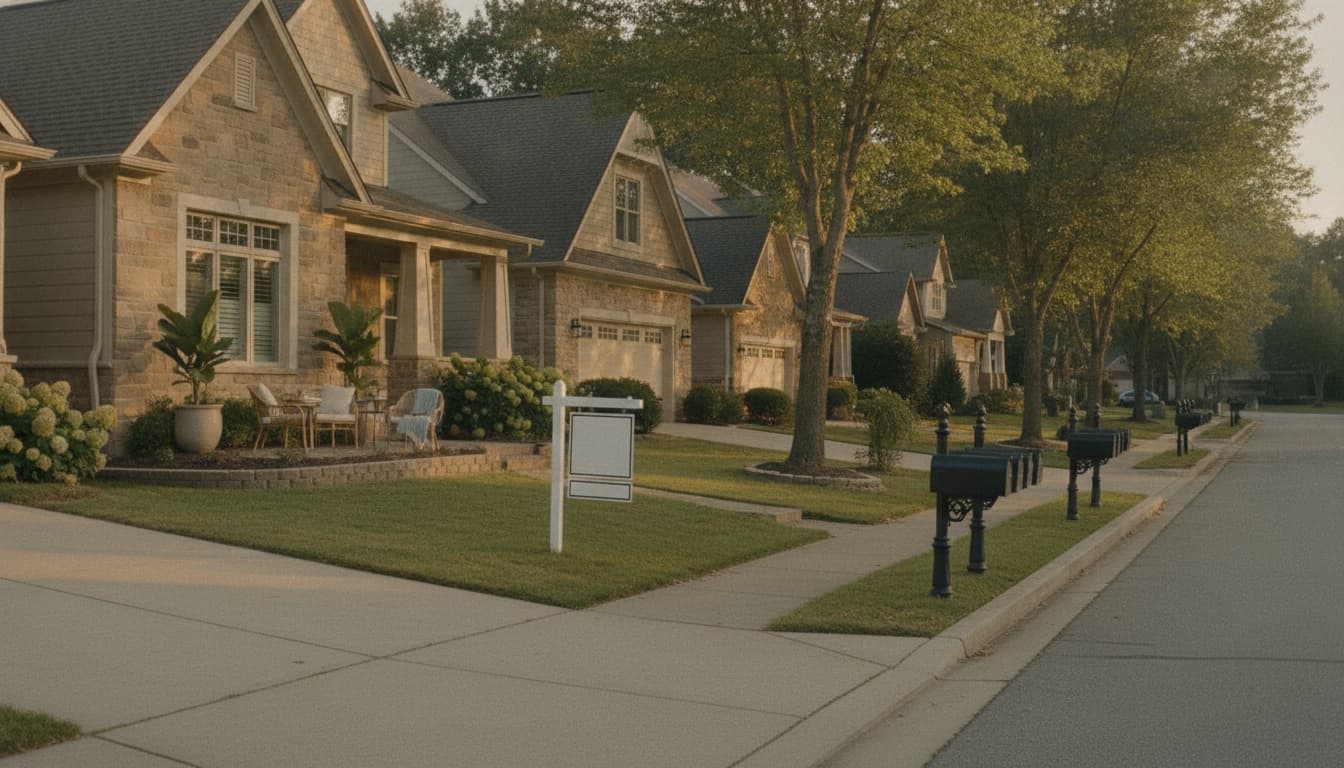
 Property Listing Promotion
Real estate farming: start where your last listings sold
Most farming guides start with a map. Start with your last listings instead: where to farm, the three numbers that say it will pay, and what to send every month.

You already farm, a little. A listing goes live and a stack of just-listed cards goes to the houses that can see the sign. It sells, and a just-sold card follows if the week allows. Then the next listing is across town, and the blocks you mailed never hear from you again.
The usual farming guides start from a map instead. Pick a neighborhood near home, check its sales numbers, buy a mailing list, and mail it every month for a year until the owners know your name. That asks you to spend the year telling strangers you're the local expert before you've sold a house on their street.
Start from the cards you already send. Those mailers around each listing are a farm with no boundary and no calendar. Give them both, on the streets where you've already sold, check the area with three numbers, and every new listing there becomes the next month's mail.
What is real estate farming?
Real estate farming is marketing to one neighborhood consistently, so its homeowners think of you when they decide to sell. NAR describes it as focusing on a specific geographic area where an agent markets consistently to become the go-to expert there. NAR's Farming & Prospecting guide The farm with a head start is the one around your recent listings, because that's where you already have proof:
1. Draw the boundary around the streets where you've listed or sold in the last two years.
2. Check that 5 to 7% or more of its homes sell each year, the turnover RPR's farming guide suggests. RPR's Ultimate Guide to Geographic Farming
3. Send every listing on those streets to the whole farm, and one useful update in the months between.
What is real estate farming?
Real estate farming, or geographic farming, means choosing one defined area (a subdivision, a condo complex, or just the streets around a park) and marketing to every home in it on a steady schedule. The aim is recall: when someone there decides to sell, your name is already the one they have in mind.
Some guides also describe demographic farming, which targets a kind of homeowner (downsizers or first-time buyers, say) instead of a place. Handle it with care. The Fair Housing Act makes it unlawful to publish a housing ad that indicates a preference based on race, color, religion, sex, handicap, familial status or national origin, 42 U.S.C. § 3604(c) and a farm defined by who lives somewhere can slide into one defined by who you'd rather work with. A geographic farm sidesteps that: every door on the street gets the same card.
Why start your farm where your listings already are?
Because a farm runs on proof, and you only have proof where you've sold. A neighbor who drove past your sign for six weeks, saw cars outside the open house and then saw the sold rider reads your next card differently from one sent by a stranger promising local expertise.
So the boundary comes from your sales history. Pull every address you've listed or sold in the last two years and pin them on a map. Where three or more sit within a few streets of each other, that's your first farm: the few hundred homes around them, whose owners pass those signs on the way home. This is the same farm our realtor marketing strategies guide recommends, the blocks around each of your listings, given a boundary and a budget.
Canvassers know a door opens differently when the house across the street already has their yard sign out. The sign tells the neighbor that someone like them has said yes. A farm drawn around your sold signs starts with that same head start.
Where you start depends on how many listings you have to build from.
Where to draw your first farm
When
Three or more of your listings in the last two years sit within a few streets
Use
Farm the few hundred homes around them
They've driven past your signs, and you have just-solds to send them
When
One recent listing, nothing else nearby
Use
Farm the blocks around it while it's on the market and through the months after it sells
Each step of the sale gives you a reason to write; widen the farm when a second listing lands nearby
When
Your listings are scattered across the county
Use
Take the cluster with the most sales in the last 12 months, then check its turnover
A farm needs enough sellers each year to pay for the mail
The fair objection: your listings might sit in a neighborhood that barely turns over, or one another agent already owns. Start from the listings, then let the area's turnover and who's listing there overrule the map.
How do you farm a neighborhood?
Set the farm up once from your own sales history, then put a touch on the calendar for every month of the next year. The setup takes an afternoon with your MLS.
- 1
Map your last two years of listings
Pull every address you listed or sold in the last 24 months from your MLS and pin them on one map. Circle the tightest cluster.
- 2
Draw the boundary and count the homes
Keep it to the few hundred homes around that cluster, on streets that could see your signs. Follow a real edge, like a main road or a subdivision line, so the farm is easy to name.
- 3
Run the three numbers
Annual turnover (homes sold in the last 12 months divided by homes in the area), who's listing those sales, and break-even (homes times touches a year times cost per touch, divided by what one listing nets you). If the farm fails the first two, move to your next-best cluster before you spend anything.
- 4
Get the mailing list
Export owner names and mailing addresses for the area from your MLS's public-records tool, RPR's mailing labels or a mailing-list service.
- 5
Put 12 months of touches on the calendar
Aim for a touch every month and never go longer than a quarter. Listing events will fill some months; plan what goes out in the rest now, so a busy week doesn't break the run.
- 6
Log what comes back
Note every call, reply and open house visitor from the farm, and every listing it wins. Judge the farm on listings won after 12 months.
For the mailing list, RPR lets REALTORS® generate up to 2,000 labels a month from any saved search, with options to skip properties already listed or on a do-not-mail list. RPR's guide to geographic farming RPR also suggests a touch at least every three to four weeks, which matches the monthly cadence in our real estate postcard ideas guide, where a small farm mailed every month beats a big list mailed once.
The usual guides run steps two and three from a map of the neighborhood you'd like to own. Here the map comes from your sales history, and the numbers check it.
What should you send your farm?
Send proof when you have it and something useful when you don't. In a month with a listing on the farm's streets, the listing is the message. In a month without one, send a short update on what sold nearby, or a note about something happening in the area.
What to send, and when
| Touch | When | What it carries |
|---|---|---|
| Just-listed card or door hanger | The week a home on the farm goes live | The photo, the street, the open house date |
| Open house invitation | The week before | An invitation that names the neighbors, not just buyers |
| Just-sold card | Within days of closing | The street and what you did to market the home |
| Listing video | Listing day, and again when it sells | The home itself, for the neighborhood Facebook group and your page |
| Market update | Months with no listing | What sold on these streets last quarter, and how fast |
| Community note | Once or twice a year | Something useful about the area, with you as the sender |
On the just-sold card, describe what you did to market the home rather than claiming it caused the sale: you can stand behind the first, and nobody can prove the second. Check your MLS's rules on advertising a sold listing, and ask the seller before you share anything that isn't already public. The rest of the per-listing sequence (listing day, the blocks around it, the open house invitation) is laid out step by step in realtor marketing strategies.
Of the touches in the table, the open house invitation does the most, because it gets neighbors through the door to watch you work. Open house marketing ideas has the rest of that playbook, and the farming section of real estate flyers covers the piece you leave on a doorstep.
How long does real estate farming take to work?
Give it a full year before you judge it. Sellers in NAR's 2025 Profile had owned their homes for a median of 11 years before selling, NAR 2025 Profile of Home Buyers and Sellers so in any given year most of your farm isn't moving, and the few owners who are could decide at any point in it.
While you wait, judge it on listings rather than calls. Calls per card will look bad for months. Listings won from the farm over 12 months is the number to judge it on, the same test our postcard guide sets. Earlier signs are worth logging too: neighbors at your open houses, replies to the market update, someone from the farm asking for you by name.
Year two is when a listing-led farm should pull ahead. Every listing you win there adds another sold sign to the streets you're already mailing, so more of the just-solds you send come from the reader's own street.
What keeps a farm fed in your busiest weeks?
A listing-led farm has one weak spot: the week you're too busy to make anything. Two closings and a new listing land together, the just-listed card for the house down the street never gets made, and the farm hears nothing about the one event it would have cared about.
Dunphy helps in that week. It's the AI marketing agent for real estate listings, and it starts with the listing video, made from the listing photos you already have. That gives you something to post in the neighborhood Facebook group on listing day, and again with the news when it sells, while the card is still at the printer.
It won't pick your farm, pull the mailing list or mail the cards. Those stay with you and your print vendor. What it covers is the content each listing should leave behind, so the farm keeps getting proof in the weeks you can't stop to make it. For the months between listings, a neighborhood video keeps working the farm's feeds after the listing video has done its job.
Frequently asked questions
What does farming mean in real estate?
How do you farm a neighborhood for real estate?
How do you choose a real estate farming area?
How many homes should be in a real estate farm?
What is a good turnover rate for a real estate farm?
Does geographic farming still work?
Dunphy is the AI marketing agent for real estate listings. It starts with the listing video, so every home you sell leaves something to show the streets around it. Photos in. Video out.

Written by
Matthew JohnCo-founder & CEO, Typito AI
Co-founder and CEO at Typito AI. I've been dabbling with video storytelling for 15 years and every day on the journey has been exciting. At Typito we're building Dunphy — the AI video agent for real estate — alongside the broader Typito video stack. Writing here about real-estate marketing, video, and integrity in AI-generated content.