 Templates & Marketing Resources
Real estate flyers: what to put on one (and what to cut)
What belongs on a real estate flyer and what to cut, the fridge test that decides if it works, plus the free template tools worth using for listings and open houses.

Open house is Saturday. You open Canva, drop in the exterior photo, and start typing: 4 bed, 3 bath, 2,400 sq ft, $525,000, new roof, updated kitchen. Address across the top, your headshot in the corner. Print fifty. Done.
That flyer is fine. It's also forgettable, and forgettable is the only way a flyer fails. The buyer standing in the kitchen already has the MLS listing open on their phone. Every spec you printed, they can see, sourced better, with more photos. So if the flyer's job is to tell them the beds and baths, the flyer has no job. Its actual job starts when they walk out the door.
What should a real estate flyer include?
A real estate flyer needs one strong photo, one line that gives a reason to care, the price and address, three or four features that aren't obvious from the photos, a QR code to the full listing or listing video, and your name, brokerage, and contact. Everything else is padding. Lead with the photo and the hook; put the specs and your branding in a clean margin, not across the top.
The fridge test
Here's the standard I'd hold every flyer to: will it survive a week on a kitchen counter? A buyer at a Saturday open house sees four to six homes. They come home with a stack of flyers and drop them on the counter. By Wednesday, when they're actually deciding which two to revisit, most of that stack is in the recycling and they're going off memory. The flyer that made the cut is the one that gave them a single thing to remember the house by. Not the square footage. The screened porch that made them picture summer, or the fact that it's the only one they saw under budget with a real yard.
That's the whole design brief. A flyer isn't a spec sheet, it's a memory aid. Design it to lose gracefully to the recycling bin, or to win the counter.
A movie poster never tells you the plot. It gives you one image and one line, and its entire job is to make you want to see the film, not to summarize it. The house is the film. The MLS listing is the plot summary anyone can read later. Your flyer is the poster, so stop writing the summary and start selling the reason to walk in.
What to include, what to cut
What earns its place on a listing flyer
Include
- One hero photo, bigThe single best shot, filling most of the sheet. Not a grid of six thumbnails that shrinks your strongest image to a stamp.
- One line that gives a reason to careThe screened porch, the walk-to-town location, the only-one-under-$500k-with-a-yard angle. The thing the photos alone won't say.
- Price and addressClear, but not the headline. A buyer needs it; it isn't what makes them remember the house.
- Three or four non-obvious featuresNew roof, finished basement, low HOA. Skip 'spacious living room' and anything the photo already shows.
- A QR code to the listing or listing videoThis is where the flyer beats paper: it hands the counter-side buyer a tap to the full media.
Skip
- A wall of specificationsBeds, baths, sqft, lot size, year built, taxes, all of it. They have the MLS for that. A flyer that reads like a spec sheet gets skimmed and dropped.
- Your logo and headshot across the topBrand yourself in a clean margin. The top of the flyer belongs to the house, not to you.
- Five different fonts and three colorsTemplate maximalism reads as amateur. One typeface, one accent color, lots of white space.
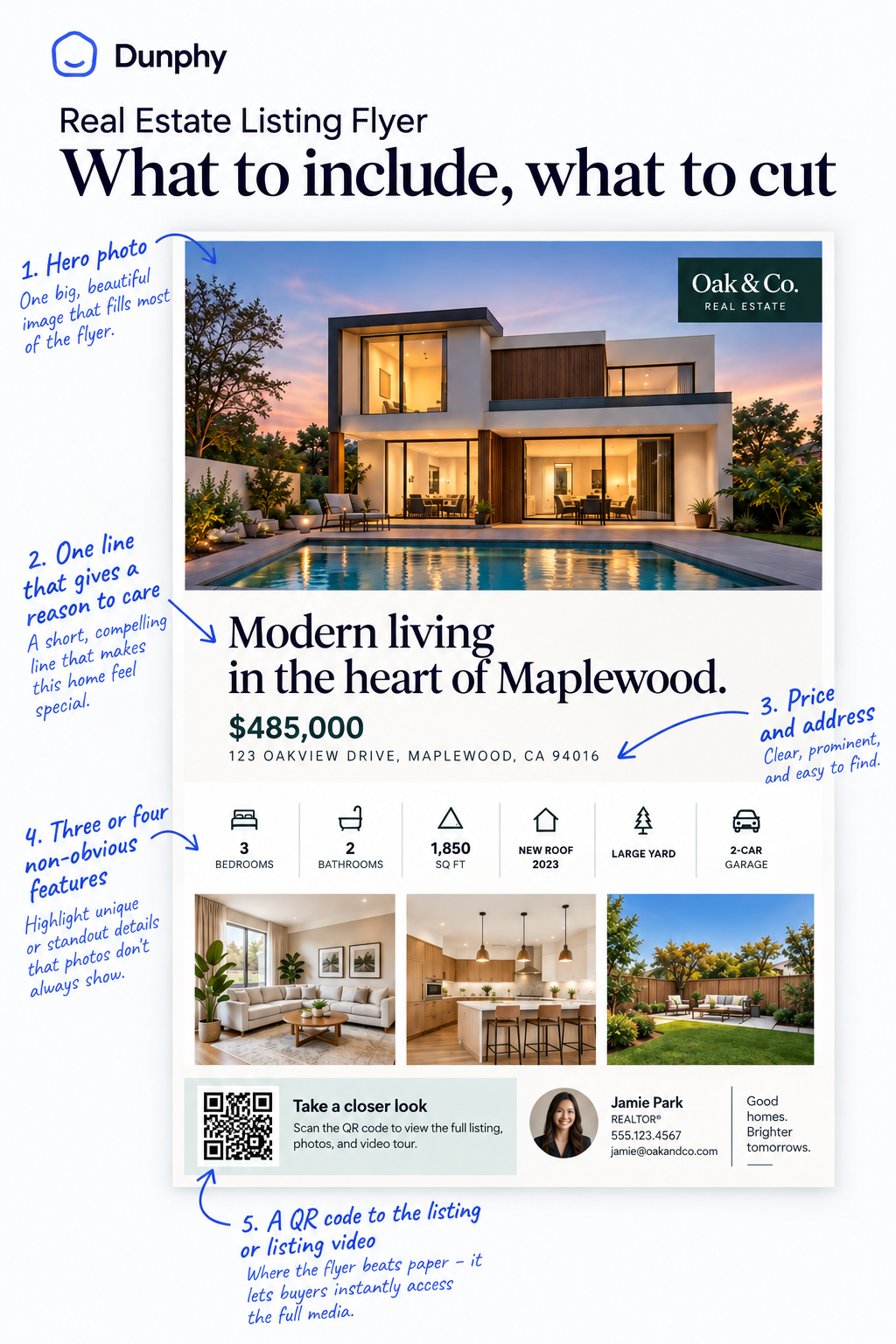
An illustrative flyer layout: where each element earns its place, and what to leave off.
Where to actually get the flyer
You don't need to design from scratch, and you don't need a designer. The practical free and low-cost options fall into two camps: design tools you export and print yourself, and print-and-ship services that mail you the finished stack.
- Design-it-yourself: Canva and Adobe Express both have large free real-estate flyer template libraries. Pick one clean layout and reuse it every listing so your flyers start to look like a set, not a scramble.
- Print-and-ship: Vistaprint and Wise Pelican handle full-color printing on decent cardstock and ship to you, which is worth it for open-house volume where a home-printer flyer feels cheap in the hand.
Naming these isn't an endorsement of any one; they're where the templates are. The design decision that matters more than the tool is the one above: pick a layout that leads with the photo and holds one hook, then keep using it.
The farming flyer that wins your next listing
The question behind a lot of flyer searches isn't "how do I market this house," it's "how do I use flyers to get listings." Different flyer, same principle. A just-listed or just-sold flyer dropped in the surrounding blocks is a farming tool, and it works on recall, not on a single drop. The neighbor who gets your "just sold at 42 Maple, over asking" card doesn't call today. They call in eight months when they're ready, if you're the name they remember. That's a repetition game, and it's the same logic behind real estate postcard ideas that farm a neighborhood, so treat a farming flyer as one touch in a sequence, never a one-off.
What to do this week
- Open your last flyer and cover everything except the photo and the top line. If a stranger couldn't tell why this house matters from what's left, it failed the fridge test.
- Rebuild it around one hero photo and one reason to care. Move the specs to a small block and your branding to the margin.
- Add a QR code that opens the listing or its video, so the flyer keeps working after the buyer leaves.
- Save that layout as your template and use it for every listing, so your flyers start to look like they came from the same agent.
The flyer was never going to sell the house at the open house. It's there to win the kitchen counter three days later, when the buyer is deciding what to remember.
Frequently asked questions
Where can I make real estate flyers online for free?
What should a real estate flyer say?
How do I use flyers to get listings?
What's the cheapest way to make real estate flyers?
Do real estate flyers still work?
A flyer is static and it lives on a counter. That's its strength and its ceiling. The one thing it can't do is show the house in motion, and motion is what the listing page and the social feed reward. That's the honest role for Dunphy, and it isn't making your flyer. Dunphy is the AI video agent for real estate: it turns the listing photos you already have into short videos for the surfaces a flyer can't reach. The clean handoff is a QR code on the printed flyer that opens the listing's video, so the paper does the open-house job and the tap does the rest. For the wider stack of what to run per listing, tools for real estate marketing covers the kit, and how to market a property listing is the full channel sequence a flyer slots into.
Photos in. Video out.

Written by
Matthew JohnCo-founder & CEO, Typito AI
Co-founder and CEO at Typito AI. I've been dabbling with video storytelling for 15 years and every day on the journey has been exciting. At Typito we're building Dunphy — the AI video agent for real estate — alongside the broader Typito video stack. Writing here about real-estate marketing, video, and integrity in AI-generated content.