 Templates & Marketing Resources
Real estate brochures: what to include, examples that work, and where to get one
The template was never the hard part, what goes on it is. What to include in a real estate brochure, examples from the real estate agents who do it best, and where to get one free.

You search "real estate brochure examples," and every result is a template library: Canva, Venngage, Wise Pelican, a hundred tri-fold layouts in tasteful greys. You pick one, drop in the photos and the specs, hit export. Done.
Except the template was never the hard part. What goes on it is. A brochure with a beautiful layout and nothing to say is a nicely-set spec sheet, and the buyer holding it already has the full MLS listing open on their phone, with more photos and better search than your sheet will ever have. So the first question isn't which template. It's what a brochure is for, and what has to be on it to survive the trip from a buyer's hand to their kitchen counter.
What should a real estate brochure include?
A real estate brochure needs seven things, in order of what matters:
1. One strong hero photo, given real space, not a grid of thumbnails.
2. One line that earns attention: a reason to care about this home, not a summary of its specs.
3. Price and address, present but never the headline.
4. Three to five non-obvious features: the school zone, the low HOA, the new roof.
5. A short, human paragraph on the life the home offers, the part paper can carry that a listing card can't.
6. A QR code to the full listing or the listing video.
7. Your name, brokerage, and contact, in a clean margin.
Everything past that is padding. Lead with the photo and the hook. Keep the specs and your branding in the margins, not across the top.
A brochure isn't a bigger flyer
People use the two words interchangeably, and it costs them. A real estate flyer is one sheet with one job: be the thing a buyer remembers after the open house. A brochure has more room, multiple panels or pages, and that room only pays off when the property has a fuller story to tell: a luxury listing that justifies a narrative, a leave-behind at a listing appointment, a developer's pre-sale piece.
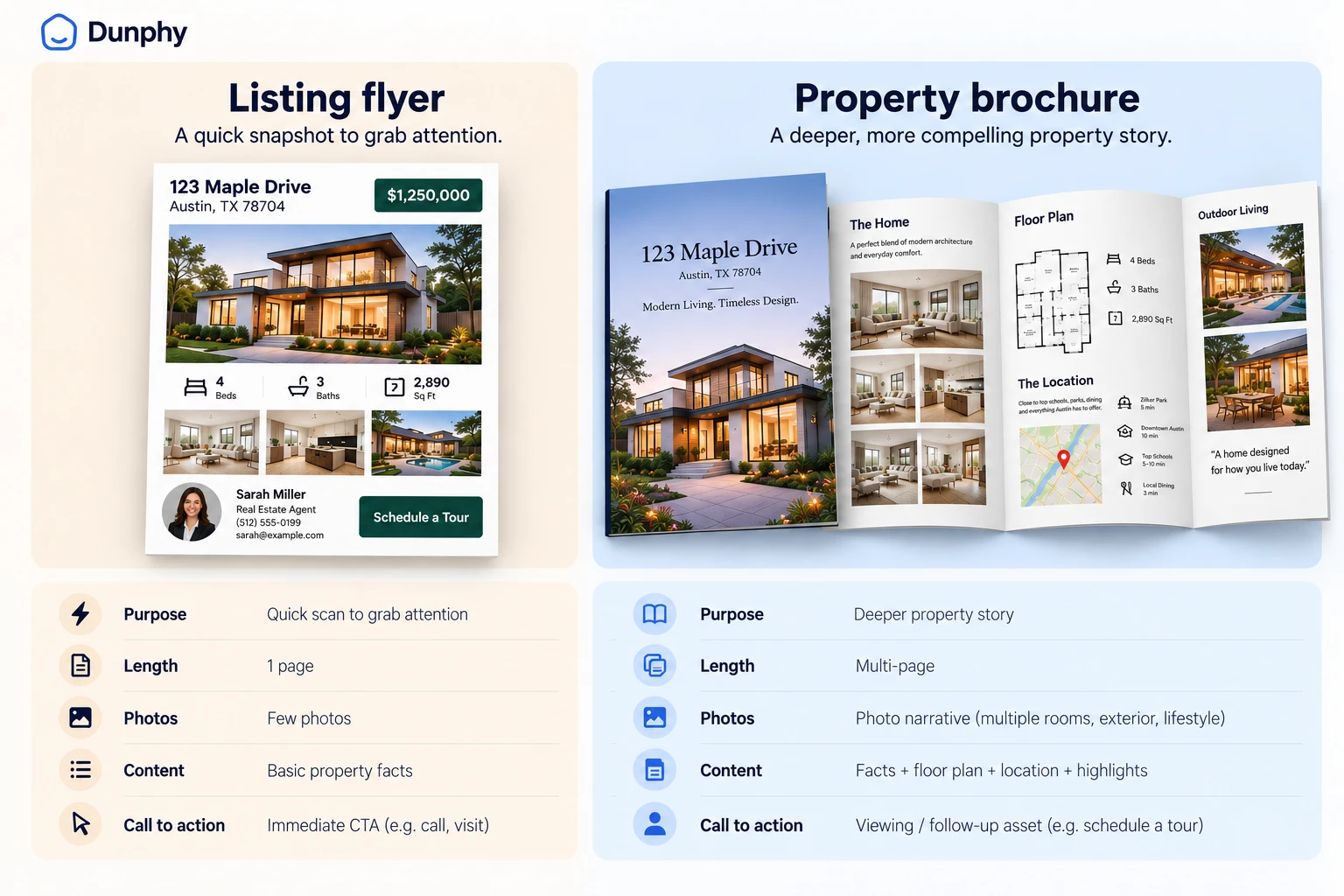
Illustrative: the flyer grabs attention in a single page; the brochure tells the fuller story across several.
But room is a trap. The flyer stays disciplined because its size forces it to. A brochure hands you empty panels and quietly dares you to fill them, and most real estate agents take the dare: the panels swell with paragraphs no one reads. The rule that rescues a brochure is the same one that rescues a flyer. Every panel earns its place, or it comes out.
A museum's exhibition catalogue never reproduces the whole show. It gives you a few plates and one short essay, just enough to make you want to stand in the room and see the rest for yourself. A brochure is doing that same job for a house: not the full record, but the reason to come and walk through it.
What to include in a real estate brochure, and what to cut
What earns its place in a real estate brochure
Include
- One hero photo, largeThe single best shot, filling a full panel. Not six thumbnails that shrink your strongest image to a stamp.
- A lifestyle line and a short paragraphThe reason to want this home, in words. This is the room a brochure has that a flyer and a listing card don't.
- Three to five non-obvious featuresSchool zone, HOA, roof age: the things a photo won't tell them. Skip anything the photo already shows.
- A clean specs blockBeds, baths, sqft, lot. Present, but in a tidy sidebar, not the headline.
- A QR code to the listing videoThe one move that makes paper do what paper can't: hand the reader a tap to the full media.
- Contact and brokerage in the marginFindable, not dominant. The property leads; you sign it.
Skip
- A wall of specifications on every panelThey have the MLS for that. A brochure that reads like a data sheet gets set down.
- Paragraphs of company historyThe buyer came for the home. Trim the 'about us' to a line.
- Five fonts and three accent colorsOne typeface, one accent, lots of white space. Template maximalism reads as amateur.
Real estate brochure examples, by the job each does
"Examples" is the most common brochure search, and most galleries answer it with pretty layouts and nothing else. More useful is to sort the examples by the job, because the job decides the design. Then look at who does each job best.
Types of real estate brochure and what each is for
| Brochure | The job | Where it's used | What leads |
|---|---|---|---|
| Single-listing brochure | Sell one specific property | Open house, listing-page download, buyer email | The hero photo and one lifestyle line |
| Luxury property brochure | Justify the price with a narrative | Private showings, high-end mailers | Photography and story, minimal copy |
| Listing (leave-behind) brochure | Stay on the counter after a showing | Handed out on the day | One memorable feature, a QR to video |
| Real estate agent / capabilities brochure | Win the next seller | Listing appointments, referrals | A specific plan, one or two proofs |
| Developer / pre-sale brochure | Sell before it's built | Launch events, investor outreach | Renders labeled as renders, the vision |
Here's each type done well, with a real example worth studying and when to reach for it.
The single-listing brochure
The one most real estate agents mean, and the one to master first: a hero photo, a lifestyle line, one short paragraph, a clean specs block, and a QR code. For a model of restraint, look at how The Agency, Mauricio Umansky's brokerage and the shop behind headline listings like the Playboy Mansion and the Walt Disney Estate, presents a single property. Its in-house creative team builds each listing's brochure around one story and strong photography, not a feature dump. Copy that discipline whatever your price point.
See it: The Agency
When to use it: your everyday listing. This is the default brochure you'll reach for most.
The luxury property brochure
The same skeleton, with the copy turned down and the photography turned up. This is Sotheby's International Realty territory: the brand's reputation was built partly on magazine-style property brochures, and its high-end listings still lead with them, full-bleed images, sparse words, the home doing the talking. Ryan Serhant's top-tier work runs on the same instinct, extended into a mixed-media suite. The lesson isn't the budget. It's the confidence to let one great photograph carry a page.
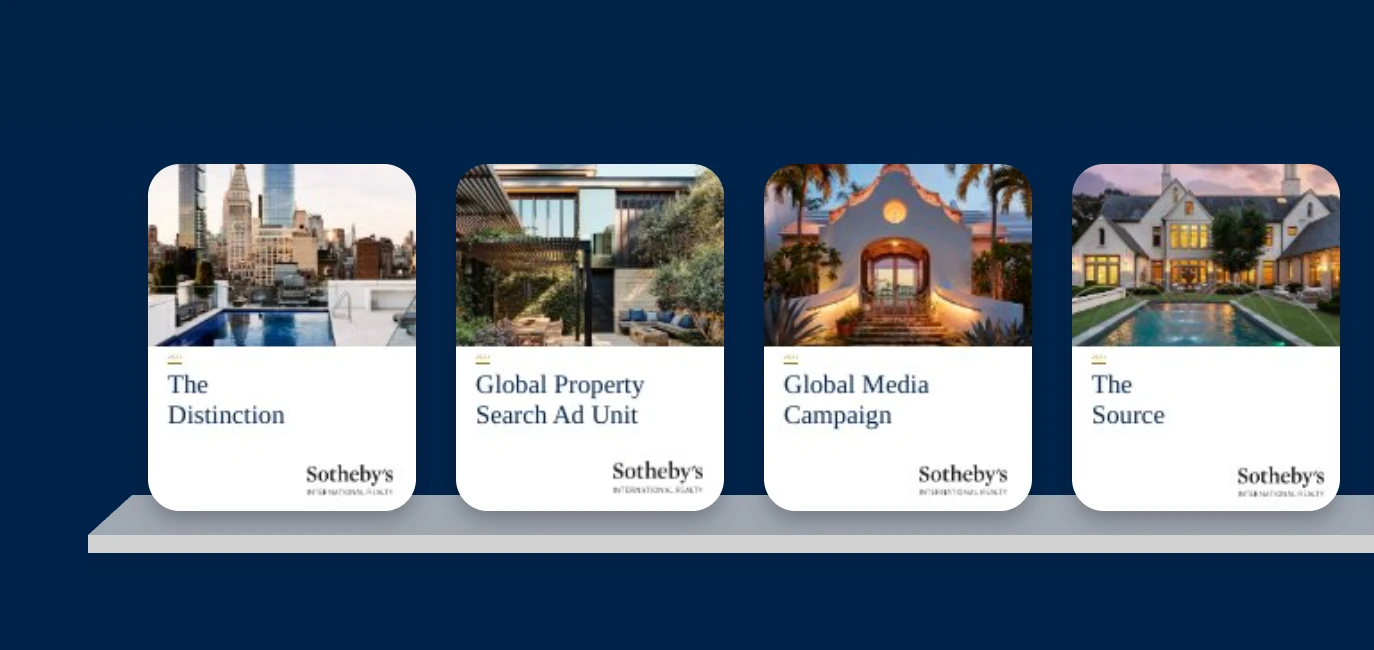
Sotheby's International Realty's brochure suite: cover-led, photography-first, barely a word of copy. View the brochures →
These designs are featured as examples for learning purposes only. We are not endorsing or advertising any brand or designer, and claim no affiliation with them.
When to use it: high-end or architecturally distinctive listings, where the property justifies a real narrative.
The listing (leave-behind) brochure
Really a flyer with a second panel, the thing a buyer walks out holding. Judge it by the same fridge test as a flyer: will it survive a week on the kitchen counter, or is it in the recycling by Wednesday? One memorable feature and a QR code beat a full spec dump every time.
When to use it: open houses and showings, anything you physically hand a buyer on the day.
The real estate agent (capabilities) brochure
This one isn't about a property at all, which is exactly where most go wrong: they turn into an awards wall. The fix is to treat your own brand as the product, backed by a specific plan. Lead with how you'll market this seller's home and one or two real results, the same way a strong listing presentation does. A logo and a list of certifications is not a plan.
A designed real estate marketing piece on Behance, by Md Jahangir Alom. Featured as an example for learning purposes only. We are not endorsing or advertising any brand or designer, and claim no affiliation.
When to use it: listing appointments and referral outreach, where the job is to win the next seller.
The developer / pre-sale brochure
Sells a home that doesn't physically exist yet, so it lives or dies on the vision, and on honesty. Renders carry the story, but label every one as a render, never passed off as a photo.
A luxury real estate brochure design on Behance, by MD Raihan Hossain and PiXto. Featured as an example for learning purposes only. We are not endorsing or advertising any brand or designer, and claim no affiliation.
When to use it: new-construction launches and investor outreach, before the build is finished.
Label anything that isn't a real photo
If a brochure shows something the buyer won't find at the showing, a developer render, a virtually staged room, a twilight sky dropped onto a daytime shot, say so plainly on the page. A buyer who senses a brochure oversold the home walks into the showing already discounting everything you told them, a deeper hole than a plainer, honest brochure would ever have put you in. Sell the real property well. Don't manufacture a better one.
Where to get a real estate brochure template
You don't need a designer, and you don't need to start from a blank page. The options split into two camps, tools you design in and export yourself, and services that print and ship the finished stack:
- Design-it-yourself: Canva and Venngage both have deep free real-estate brochure libraries (bi-fold, tri-fold, multi-page). TheGooDocs has free Google Docs and Word versions if you'd rather edit there.
- Print-and-ship: Wise Pelican and Smartpress print full-color on real cardstock and mail it to you, which earns its cost on the folds and paper weight a home printer can't fake.
Naming them isn't an endorsement of any one. It's just where the templates are. The decision that outranks the tool is the editorial one from earlier: pick a layout that leads with the photo and holds a single story, then reuse it so your brochures start to look like a set instead of a scramble. If you want the free helpers we built for the repeatable pieces of a listing, they live at tools.
New and creative real estate brochures for 2026
The template SERP hasn't caught up to where brochures are actually headed. In 2026, the ones that outperform stop being a static handout and become the entry point to something bigger: trackable, interactive, and almost always bridging to video. Five worth trying:
The QR-to-video brochure
Put a QR code on the printed piece, and on a bigger listing, one in each room, that opens the listing video, the walkthrough, or the drone footage. Paper does the in-hand job. The tap does the motion. It's the lowest-effort upgrade on this list, and the one every brochure should already have.
Best for: every listing. Treat it as the 2026 default, not a nice-to-have.
The digital flipbook
A shareable, page-turning brochure you send as a link or QR instead of a flat PDF, built in a tool like Flipsnack, Issuu, or FlippingBook. It embeds video, links out to maps and mortgage calculators, and updates after you publish. The real edge: it tells you who opened it and how long they stayed.
Best for: email and social distribution, and any listing where you want to see engagement, not guess at it.
The interactive (immersive) brochure
A digital brochure with the tour built in: an embedded virtual walkthrough, an interactive floor plan, clickable school-district and neighborhood links, a map. It keeps a buyer moving through the property instead of skimming a sheet, and it quietly casts you as the tech-forward real estate agent in the running.
Best for: relocation and out-of-area buyers who can't stop by in person.
The personalized brochure
Variable-data printing and per-recipient QR codes let you hand each buyer, or each farmed homeowner, a version addressed to them. Gate the full digital brochure behind a name and email, and every viewer becomes a tracked lead.
Best for: farming a neighborhood and working a buyer list, where lead capture matters more than raw reach.
The lifestyle lookbook
Drop the spec-sheet framing and build a magazine-style piece around lifestyle photography, the kitchen mid-dinner, the patio at golden hour, and the neighborhood itself. It sells the life the home offers, which is exactly the part a listing card can't.
Best for: luxury and lifestyle-driven markets, where the feeling is the pitch.
The thread running through all five: the brochure is now a bridge, and what it bridges to, more often than not, is video.
Which brochure should you make?
Six situations, six answers. Match the listing in front of you to the brochure that fits.
Pick the brochure that fits the listing in front of you
When
A standard listing with an open house this week
Use
Single-listing brochure, with a QR to the listing video
The everyday workhorse; the QR adds the motion paper can't
When
A luxury or architecturally distinctive home
Use
Luxury brochure, or a lifestyle lookbook
Let photography and story carry the price
When
A listing appointment on the calendar
Use
Real estate agent (capabilities) brochure
You're selling yourself, not a property
When
Farming a neighborhood or working a buyer list
Use
Personalized or just-listed brochure
Recall and lead capture beat raw reach
When
Relocating or out-of-area buyers
Use
Interactive digital flipbook
Bring the tour to them, and see who's engaged
When
New construction before it's built
Use
Developer / pre-sale brochure, renders labeled
Sell the vision, honestly
What to do this week
- Open your last brochure and cover everything except the hero photo and the top line. If a stranger couldn't tell why this home matters from what's left, that's your fix.
- Rebuild it around one hero photo, one lifestyle line, and a short paragraph. Move the specs to a sidebar, your branding to the margin, and save the layout so every brochure reads as the same real estate agent.
- Add a QR code that opens the listing or its video, so the paper keeps working after the buyer leaves.
- Pick one 2026 upgrade for your next listing: a shareable flipbook, or a per-room QR code. See which your buyers actually open.
Frequently asked questions
What should be included in a real estate brochure?
What's the difference between a real estate flyer and a brochure?
How do I make a real estate brochure for free?
What is a digital real estate brochure?
What is a listing brochure?
Can ChatGPT or AI make a real estate brochure?
How many pages should a real estate brochure be?
A brochure lands in a hand and settles on a counter. Its strength is also its limit: it can't move. Every 2026 upgrade above leans on the one thing paper can't produce on its own, motion. A printed brochure needs something for its QR code to open. Even a digital flipbook needs a video to embed. The format can carry a walkthrough, it can't generate one. And motion is what the listing page and the social feed reward, since most buyers now meet a home on a screen long before they see it in person (NAR's Profile of Home Buyers and Sellers finds the same online-first pattern every year).
That gap is where Dunphy fits, and it isn't printing your brochure. Dunphy is the AI video agent for real estate: it turns the listing photos you already have into the short videos a brochure can't be, a listing-card clip, a social cut, a listing-page tour. The paper does the in-hand job. The tap on the QR code opens the home in motion. For the rest of the kit a brochure sits inside, tools for real estate marketing covers the stack, and how to market a property listing walks the full sequence.
Dunphy is the AI video agent for real estate. Turn the listing photos you already have into the short videos your brochure's QR code should point to. Photos in, video out.

Written by
Matthew JohnCo-founder & CEO, Typito AI
Co-founder and CEO at Typito AI. I've been dabbling with video storytelling for 15 years and every day on the journey has been exciting. At Typito we're building Dunphy — the AI video agent for real estate — alongside the broader Typito video stack. Writing here about real-estate marketing, video, and integrity in AI-generated content.