 Real Estate Social Content
Just sold post vs giant-key photo: what sellers notice
Why the closing-table photo gets scrolled past, and the four parts of a just sold post that the next seller on the street actually reads.

The keys are handed over. Somewhere in your camera roll there's the photo from the closing table: your clients, an oversized cardboard key, everyone smiling. It's ready to post, and half the real estate coaches in your feed are telling you not to bother, because nobody cares about your just sold posts.
They're half right. Nobody outside the family cares about the closing table. One person does care how that house sold, though: the homeowner three doors down who has been wondering what theirs would fetch and which agent to call. A just sold post written for that person is still worth making. The giant-key photo just isn't written for them.
What should a just sold post show?
A just sold post should show the house, one result and how you marketed it, then end with one ask. Written that way, it's for the next seller on the street rather than for your followers.
1. The house, as it was marketed: the first frame of your listing video, with SOLD on it.
2. One result: days to an offer, the number of offers, or simply that it sold.
3. How you marketed it: two or three moves, in the order they happened.
4. One ask: an offer to show the next seller the same plan.
Are just sold posts still worth posting?
Yes, as long as you post the version the next seller reads. The case against just sold posts is a case against one kind of post, the closing photo, which tells a neighbor who your clients are and nothing about how the house sold.
Two just sold posts, written for two different people
| The giant-key post | The how-you-sold-it post | |
|---|---|---|
| Written for | Your clients and their friends | The homeowner on that street who sells next |
| First frame | People at a closing table | The house, as buyers first saw it |
| What it says | Congratulations | One result, and how you got it |
| What a neighbor learns | Who bought the house | What you'd do with theirs |
| The ask | None, or a home-value form | One line offering the same plan |
Post the closing photo if your clients want it. It's good personal news, and on Facebook it belongs on your profile (more on that below). Just don't count it as your just sold post.
A consulting firm's case study is written for the next client, not the one it describes. It sets out the problem, what the firm did and what changed, and when the client would rather stay anonymous it says "a regional bank" and carries on. A just sold post does the same job for the next seller: it shows the house and how you marketed it, and leaves the clients out unless they want to be in it.
What should a just sold post include?
Four parts, in this order: the house as it was marketed, one result, how you marketed it, and a one-line ask. Everything else, from hashtags to a confetti graphic, is optional.
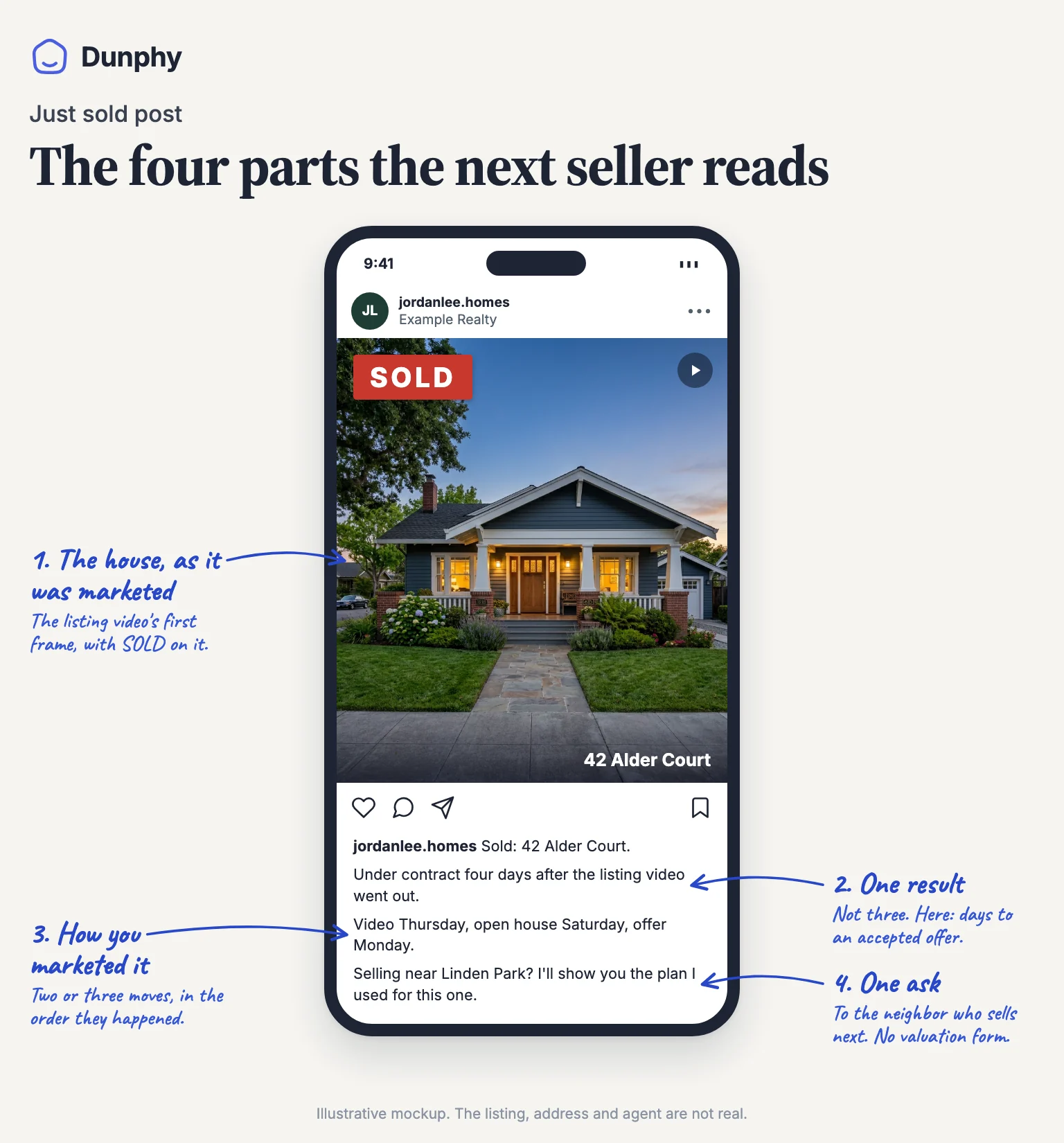
The mockup above is illustrative: we wrote it, and the listing isn't real. Here's what each part is doing.
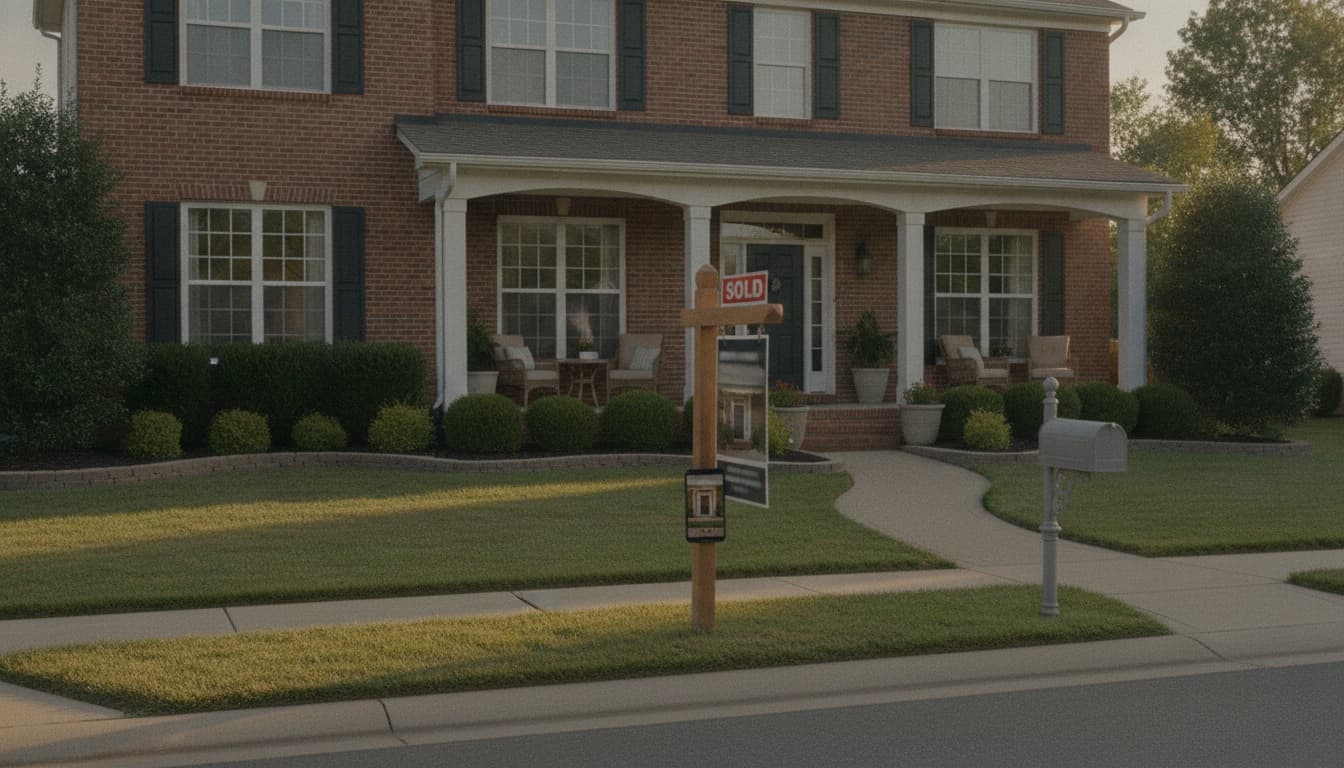
The house, as it was marketed. Use the first frame of your listing video, or the exterior photo that led the listing if it went out with photos only, with SOLD across it as a text overlay in whatever app you already edit in. Anyone who saw the listing will recognize the house before they read a word, and anyone who didn't still sees the house. A photo of people tells them nothing about it.
One result. One number, not a stats block. "Four days" sticks; a graphic with five figures on it doesn't. Which one to choose is the next section.
How you marketed it. Two or three moves in the order they happened: "Video Thursday, open house Saturday, offer Monday." This is the part the giant-key post leaves out, and it's the part a homeowner comparing agents is looking for. Keep it to what you did, and leave out why your sellers moved; that's theirs to share.
One ask. One line, for example: "Selling near Linden Park? I'll show you the plan I used for this one." Skip the home-value form. That turns the post into a lead-generation ad, the same reason our just sold Facebook ad leaves it out. Name your brokerage on the post too, or at least one tap away: if you're a REALTOR®, NAR's Code of Ethics requires your firm's name on any ad for a listed property, either in the ad itself or, online, through a link to your disclosures.
Put together, the caption is four short lines. Swap in your own details:
Sold: [street address].
[Your one result, e.g. "Under contract four days after the listing video went out."]
[How you marketed it, e.g. "Video Thursday, open house Saturday, offer Monday."]
Selling near [neighborhood]? I'll show you the plan I used for this one.
For other opening lines, the two just sold hooks in our real estate captions guide slot straight into the first line.
Which result should you put in a just sold post?
The one that says the most about how you sold it. For most listings that's the days it took to get an offer, or the number of offers; when neither stands out, "sold" and the street name are enough.
Pick one result, based on how the sale actually went
When
It went under contract quickly
Use
Days to an accepted offer
A neighbor understands "four days" with no context
When
Several buyers made offers
Use
The number of offers
It shows buyers competed for the house
When
It sold at or above the asking price
Use
How the sale compared with the asking price
It's the first thing a neighbor weighing their own price looks for
When
It sat, then sold after you changed something
Use
What you changed: new photos, a new video, a price improvement
The turnaround is the story, so lead with it
When
Nothing about the sale stood out
Use
"Sold" and the street name
That you sell on their street is the result a neighbor cares about
When
You represented the buyer
Use
What your buyers were after, and that they got it
It shows you know the street from the buying side too
Choose one. Three numbers in a graphic read as a report; one reads as a fact.
If you represented the buyer, you can still call it sold. The same Code lets the listing broker and the cooperating broker, the one who brought the buyer, claim to have sold the property; before closing, the buyer's side may put up a "sold" sign only with the listing broker's consent. What it rules out is claiming a sale you weren't part of, such as a teammate's listing.
Where should a just sold post go: Instagram, Stories or Facebook?
All three, as one post adapted to each, not three new ones. The listing video goes back on your Instagram feed with SOLD on it, a Story carries the short version, and on Facebook the result goes on your business Page while the personal thank-you goes on your profile.
Instagram feed and Reels
Re-post the listing Reel with a SOLD overlay and a one-line caption. Followers who saw it on listing day recognize it straight away, and the just-sold Reel in our Reels ideas makes the case for keeping it quiet: no confetti, no celebration emojis. Name the street or the neighborhood in the first line of the caption, since that's the part a neighbor will recognize.
Stories
A Story is the reminder for people who already follow you. Use the same first frame with SOLD on it and the one result, and keep the full caption for the feed post.
Facebook Page and profile
Your business Page gets the full version: the house, the result, how you marketed it and the ask. Your personal profile gets the closing as personal news, with a thank-you to the clients if they're happy to be tagged. Our Facebook posts guide explains why the two get different versions. If you want to put money behind the Page post, the just sold ad in our Facebook ads guide is set up for homeowners near the house.
Mailing the news as well? Our postcard ideas cover the just sold card, and the same four parts work on paper.
Should you make a new video for a just sold post?
No. Bring back the listing video with SOLD over the first frame, because the house your neighbors recognize is the one they saw on listing day. A new shoot weeks after closing would show them an empty house or the new owners' furniture.
It also means one house carries one first frame from coming soon to sold, the same reuse the open house promo video post recommends for the open house clip.
No listing video? The listing photos are enough to make one now. Dunphy turns them into a Highlight Reel, so the just sold post can still open on the house buyers saw, as a video rather than a still. If you made the listing video with Dunphy in the first place, bring back the Highlight Reel you posted on listing day.
Frequently asked questions
What are you allowed to say in a just sold post?
Can a buyer's agent post a just sold?
How soon after closing should you post a just sold post?
Do you need your client's permission for a just sold post?
Start your just sold post from the listing-day video
Dunphy turns your listing photos into the video you post on listing day, so when the house sells, your just sold post starts from something the neighbors have already seen.

Written by
Matthew JohnCo-founder & CEO, Typito AI
Co-founder and CEO at Typito AI. I've been dabbling with video storytelling for 15 years and every day on the journey has been exciting. At Typito we're building Dunphy — the AI video agent for real estate — alongside the broader Typito video stack. Writing here about real-estate marketing, video, and integrity in AI-generated content.